
Whoa!
I was fumbling with a paper seed and felt something wrong. My instinct said do better, but I kept putting it off between work and family life. Hardware wallets felt clunky and seed phrases looked fragile and error-prone. Initially I thought a laminated sheet in a safe would be fine, but after nearly losing my backup during a move my priorities shifted toward something simpler yet more tamper-proof.
Really?
Seed phrases are brilliant in theory, messy in practice. They require perfect transcription, secure storage, and a willingness to accept a single point of failure if you tuck them into an envelope or a drawer. On one hand, a 12- or 24-word recovery is the canonical backup method; on the other hand, it’s very very human to miswrite, misplace, or misunderstand them. Hmm… something felt off about handing this fragile key to chance.
Here’s the thing.
Smart-card hardware wallets behave like a small, everyday object—like a credit card you can carry in a wallet but with a secure element that never exposes private keys. They’re quiet and practical, and they remove the mental overhead of memorizing or safekeeping a long seed phrase. Initially I worried about centralization and vendor lock-in, but then I dug into the threat model and the tech. Actually, wait—let me rephrase that: it’s not perfect, but for many people it offers a better balance of security and usability.
Whoa!
The main risk with seed phrases isn’t just loss; it’s accidental exposure during backups, or social engineering when relatives ask “what’s that long phrase?”. Smart-card wallets isolate the signing key inside tamper-resistant hardware so the secret never exists as text you can leak. On the technical side, the secure element is designed to resist physical and logical attacks, though no device is unbreakable if an attacker has unlimited resources and time. My gut says this solves more real-world problems than it introduces.
Seriously?
Let me get a bit nerdy for a moment: these cards use an embedded secure chip (a SE) that performs cryptographic ops without exporting the private key. The device typically supports BIP32/BIP44-style derivation or native paths for modern chains, and some implement bulletproof protections against replay and cloning. There are trade-offs—firmware bugs, supply-chain concerns, and the plain fact that you trust a manufacturer to ship uncompromised hardware. I’m biased, though: I prefer devices that make safe storage feel like carrying a credit card, not running a backend.
Whoa!
Okay, so check this out—one brand that nails the smart-card form factor for consumer use is the tangem wallet. The cards are contact-based, built with secure elements, and designed to be as idiot-proof as possible for day-to-day crypto holders. I carried one in my wallet for months and the friction was almost zero; payments, signing, and backups felt natural. That said, there were moments where I had to stop and remind myself that convenience can be a double-edged sword.
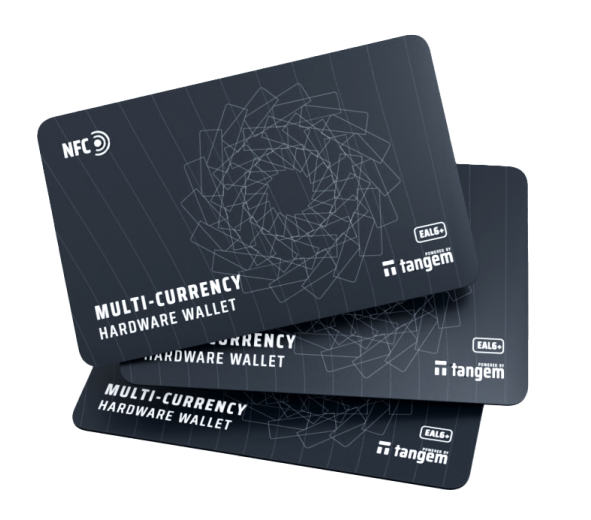
How smart-card wallets change the trust game
Hmm…
On one hand, seed phrases put recovery squarely in the user’s control; on the other, they assume near-perfect behavior from everyday humans. Smart-card wallets flip that assumption by embedding the sensitive material in hardware and giving the user a physical object to steward instead. Initially I thought that this simply traded one failure mode for another (loss vs. exposure), but I learned that the object-oriented approach reduces cognitive load significantly. For older relatives or people who dislike tech, handing them a card feels less scary than teaching them to write down 24 words correctly.
Here’s the thing.
From a security perspective, threat modeling matters: if your primary risk is phishing and remote compromise, isolating keys in hardware is a huge win; if your primary risk is an adversary who can seize and physically coerce you, then no solution is perfect. Some cards support passcodes or multi-card setups (sharding keys across devices), which provide defense-in-depth but add complexity. I’m not 100% sure about multi-card UX for nontechnical folks, but the concept works well for trustees or family inheritance plans.
Whoa!
Practically speaking, setup tends to be simpler than people expect. Most smart-card wallets come initialized so there’s no seed phrase to jot down—pair the card with an app, set a PIN, and you’re ready to go. That’s liberating for people who fear making a mistake during initialization. However, there’s a cultural hurdle: many seasoned crypto users distrust anything that removes the explicit seed phrase step because historically that phrase has been the only transparent backup. Still, UX often wins; a secure object you physically control beats a sheet of paper you forget about.
Really?
I test devices in the field: coffee shop Wi‑Fi, subway commutes, family gatherings—basic everyday scenarios that break many idealized security models. The tangem wallet card handled these conditions with minimal fuss, and the card’s durability is surprisingly good (bent pockets, keys, the usual life stuff). There’s a trade-off: if you lose the card and have no second card or recovery plan, you lose access. So smart-card strategies usually recommend a small set of practices: duplicate cards stored in different secure locations, a trusted person who knows the recovery procedure, or combining cards with a small written backup of a public recovery hint (not the seed itself).
Here’s the thing.
I’m biased toward solutions that people will actually use. The best security is the security that sticks, and many users simply won’t adopt complex cold-storage rituals. Smart-card wallets meet users where they are: everyday, low-friction, and less scary. That doesn’t mean pain-free—loss still happens, firmware flaws can appear—though the overall risk profile for typical users often improves. If you’re handing crypto to a parent or using it day-to-day, these cards are worth a serious look.
FAQ
How is a smart-card different from a ledger or other hardware wallet?
Smart-card wallets put the secure element into a credit-card form factor and are optimized for portability and minimal setup, while devices like Ledger or Trezor use separate hardware with screens and buttons that can offer richer verification flows; both approaches isolate private keys, but they trade off features, form factor, and sometimes attack surface. I’m not saying one is strictly better; it’s about fit and threat model.
What happens if I lose the card?
Then you lose access unless you prepared a recovery strategy—duplicate card, multi-card split, or a secured recovery stored offline. This is why many proponents suggest at least one geographically separated backup card; it’s not sexy, but it works.
Can these cards be cloned or tampered with?
The secure elements are designed to resist cloning and theft of private keys, but supply-chain attacks and sophisticated lab-level attacks remain theoretical risks. For everyday people, the level of protection is substantially higher than a written seed under a floorboard.